In the inert gas arc welding process with a non-consumable electrode, the heat required to melt the weld metal is provided by an electric arc struck and maintained between a tungsten electrode (or tungsten alloy) and the workpiece. The molten metal as well as the electrode are protected against the action of oxygen and nitrogen in the air by the continuous flow of an inert shielding gas. All of this constitutes the name of the process: TIG or Tungsten Inert Gas.
The electrode therefore plays a key role in the TIG process. The electrodes used are predominantly composed of more than 99% tungsten by mass, to which metal oxides are added to increase the electronic emissivity of the electrode and therefore its efficiency.
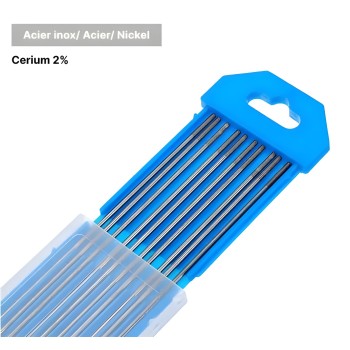
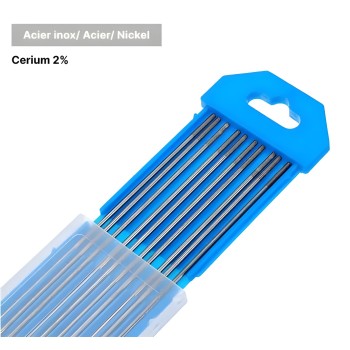
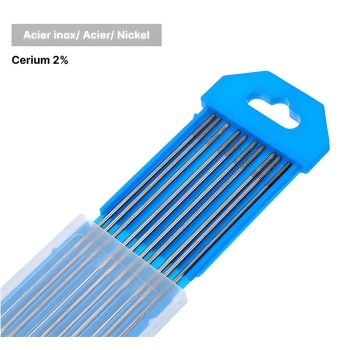
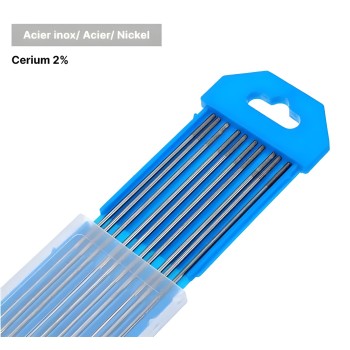
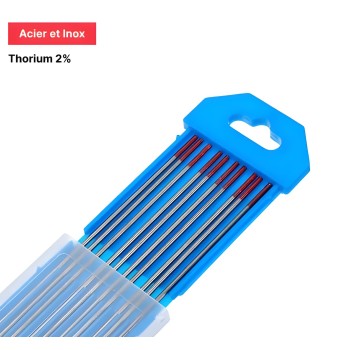
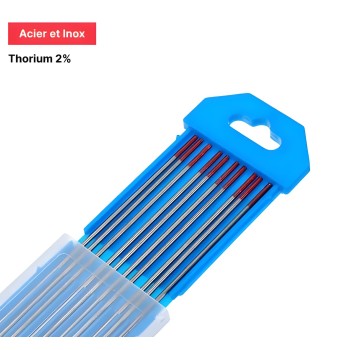
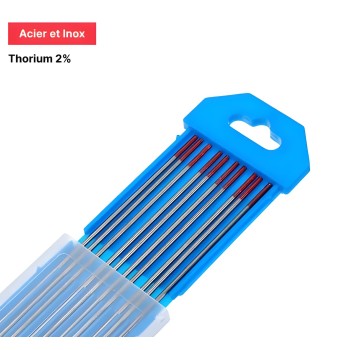
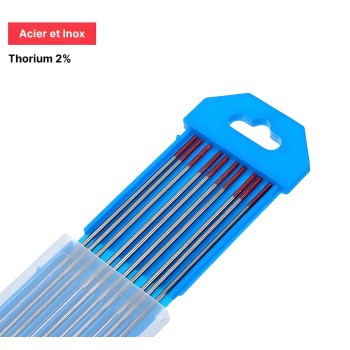
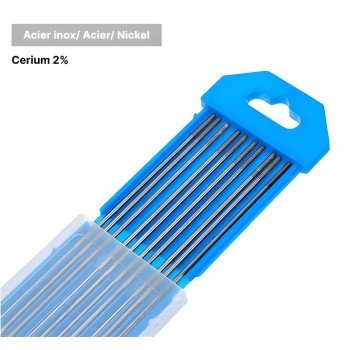
For TIG welding of steels – stainless steel, EURO-WELDING offers tungsten electrodes that stand out for their excellent arc striking performance even when re-striking with a hot electrode, and ensure consistent weld bead quality. Particularly suited for welding steel, stainless steel, nickel and titanium alloys at low to medium amperages. Suitable for automatic welding, these tungsten electrodes for TIG welding of steel – stainless steel guarantee the best results.
Welding of steels and their alloys
Depending on the application, the type of welding current, the nature of the electrode and the electrode diameter, there are several possible choices of refractory tungsten electrodes for TIG welding of steels, as shown in the following table.
|
Metal type
|
Thickness
|
Tungsten Electrode
|
Current type
|
Shielding gas
|
|
Low-alloy steel - Carbon
|
All
|
Thoriated
|
Direct DCEP
|
Argon or Argon-Helium
|
|
Thin only
|
Pure or zirconium
|
Alternating (AC)
|
Argon
|
|
Stainless Steel
|
All
|
Thoriated
|
Direct DCEP
|
Argon or Argon-Helium
|
|
Thin only
|
Pure or zirconium
|
Alternating (AC)
|
Argon or Argon-Hydrogen
|
Steels and steel alloys are generally welded in direct current, in straight or negative polarity. The table below indicates the recommended current range according to the diameter of the tungsten electrode used.
|
Electrode diameter
|
Tungsten
|
|
Ø 1.0 mm
|
10 to 80 A
|
|
Ø 1.6 mm
|
50 to 120 A
|
|
Ø 2.0 mm
|
80 to 190 A
|
|
Ø 2.4 mm
|
100 to 240 A
|
|
Ø 3.2 mm
|
150 to 300 A
|
|
Ø 4.0 mm
|
300 to 450 A
|
|
Ø 5.0 mm
|
500 to 650 A
|
Protection of the Tungsten Electrode for welding steels
The tungsten electrode must be continuously protected by a flow of inert gas (argon or helium) just before arc striking (pre-gas), during welding and after the electric arc is extinguished (post-gas) until it has cooled down. The tip of the electrode must always be bright and silver-white in colour after complete cooling. If this is not the case, the post-gas time must be increased.
The recommended post-gas delay setting for the generator is indicated in the following table.
|
Welding current intensity
|
Post-gas duration
|
|
50 A
|
5 seconds
|
|
100 A
|
10 seconds
|
|
150 A
|
15 seconds
|
|
200 A
|
20 seconds
|
|
250 A
|
25 seconds
|
|
300 A
|
30 seconds
|
Sharpening the Tungsten Electrode is essential
The geometric preparation of the tip of the non-consumable electrode is an important variable. Make sure to sharpen in such a way that the grooves converge in a direction oriented towards the axis of the refractory electrode, and not in concentric circles perpendicular to that axis. Use the fine grit of a bench grinder or a tungsten sharpening machine specifically designed for this purpose. It will have a pointed tip for DC (direct current) welding.
The tungsten must never be allowed to touch the workpiece, nor come into contact with the weld pool and/or the filler metal. Your electrode will be contaminated; it will be necessary to grind the defective area of the weld bead and re-sharpen the tip.
The tungsten electrode can be cut to length depending on the type of cap used on the torch. Cutting is done by grinding with a thin cutting disc.
Overview of Stainless Steel
Stainless steels are iron-carbon alloys (low carbon), heavily alloyed with chromium, and often alloyed with other elements such as nickel, molybdenum, titanium or niobium.
Chromium confers the corrosion resistance of steels. By combining with oxygen, it creates a layer of oxide on the surface of the parts, known as a passivation layer, as it makes the steel impermeable to corrosive products.
Steel is considered stainless from 10.5% chromium and less than 1.2% carbon.
Stainless steels hold a remarkable position with regard to a large number of aggressive media thanks to the passivity phenomenon; due to the presence of chromium. A very thin film, bonded to the base metal, prevents contact between the metal and the more or less aggressive agents in the surrounding environment.
Stainless steels do not cover all types of corrosion, hence the development of an extensive range of stainless steel grades.
The following table summarises the 3 main types of stainless steel:
|
Type
|
% Carbon
|
%Chromium
|
%Nickel
|
Application
|
|
Martensitic
|
0.1 to 1.5
|
12 to 18
|
sometimes 1 to 4
|
Cutlery, turbine parts, surgical instruments
|
|
Ferritic
|
0.02 to 0.06
|
11 to 29
|
-
|
Automotive industry, shipbuilding industry, household appliances
|
|
Austenitic
|
0.015 to 1
|
16 to 20
|
8 to 25
|
food industry, mass catering, hospitals
|
The Tungsten Electrode for Stainless Steel
When TIG welding stainless steel, welding is carried out in direct current with the electrode at the negative pole. The majority of the heat is therefore directed towards the workpiece. The electrode material is generally tungsten with 2% thorium oxide. However, thoriated electrodes emit minimal radioactive radiation. As a result, there are tungsten electrodes alloyed with so-called 'rare earths' which have a longer service life. These include tungsten electrodes with 2% lanthanum oxide (La2O3) or with 2% cerium oxide (CeO2).
An electrode diameter that is too small leads to overheating or melting of the electrode, with a high risk of tungsten inclusions in the weld. An excessively large diameter causes arc instability and/or insufficient penetration (poor width-to-depth ratio of the weld pool). When welding in direct current, the electrode must be sharpened (figure 3).
The following table provides values for electrode diameter, nozzle diameter and current intensity in straight polarity (DCEN).
|
Electrode Diameter (mm)
|
Nozzle - Inner diameter (mm)
|
Current intensity (DCEN) (A)
|
|
0,25
|
6,4
|
up to 15
|
|
0,5
|
6,4
|
5-20
|
|
1
|
9,5
|
15-80
|
|
1,6
|
9,5
|
70-150
|
|
2,4
|
12,7
|
150-250
|
|
3,2
|
12,7
|
250-400
|
|
4
|
12,7
|
400-500
|
It should be noted that the sharpening of the tungsten electrode must be done in the direction of the tip and not concentrically; the finish must be as perfect as possible (the tip must be broken – flat surface of 0.8 mm).


 Italy
Italy
 Germany
 Netherlands
 Croatia
 Denmark
 Finland
 Greece
 Ireland
 Sweden
 Norway
 Bulgaria
 Estonia
 Latvia
 Lithuania
 Poland
 Czech Republic
 Romania
 Slovakia
 Slovenia
 Hungary
 Spain
Spain



 2-year warranty