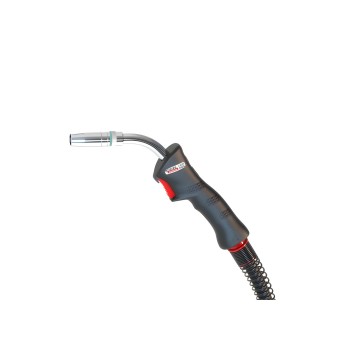
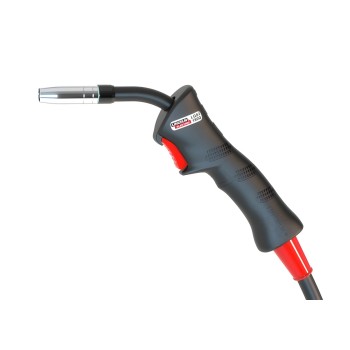
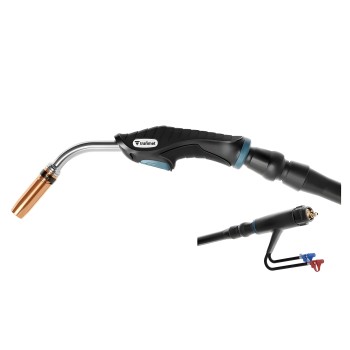
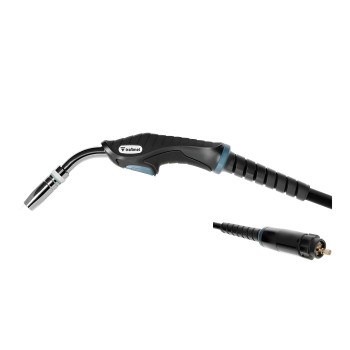
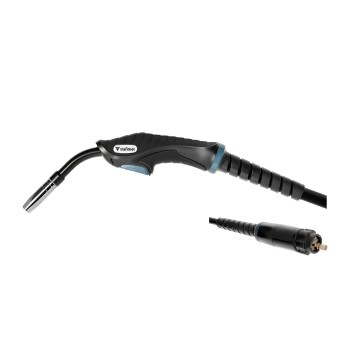
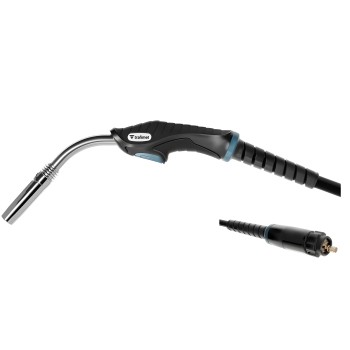
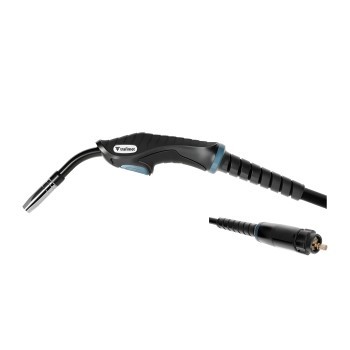
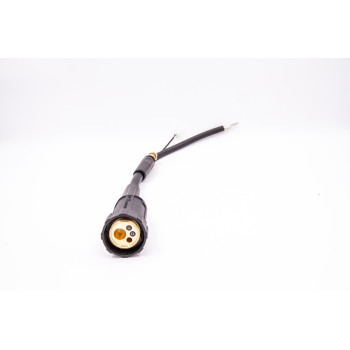
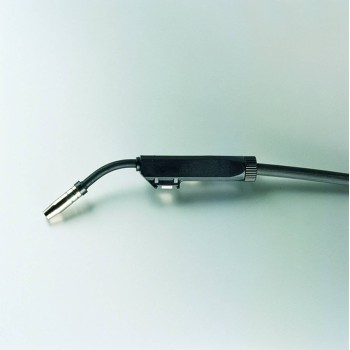
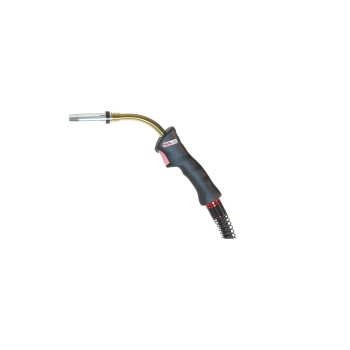
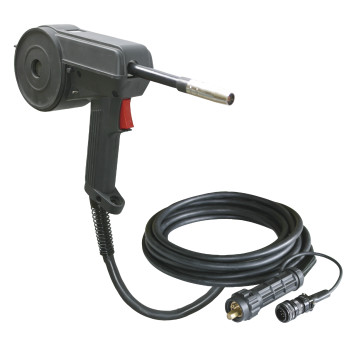
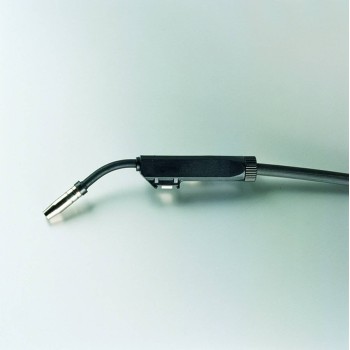
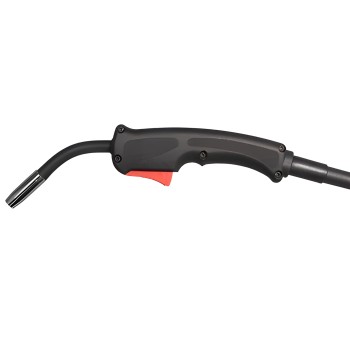
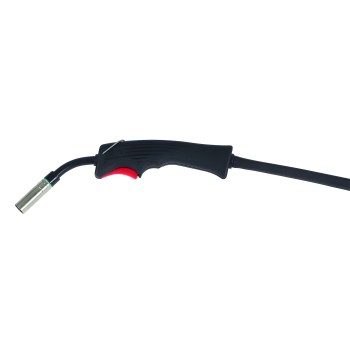
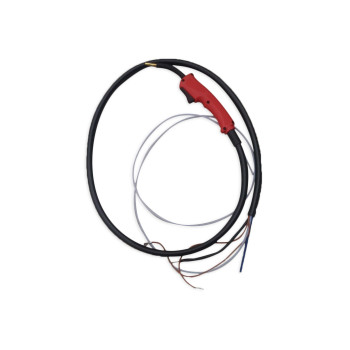
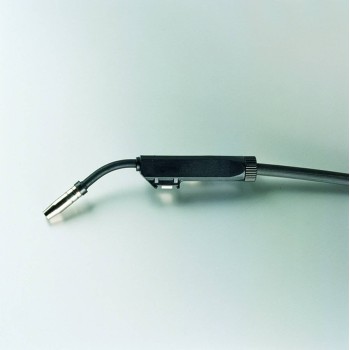
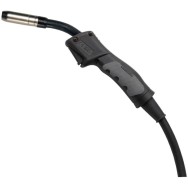
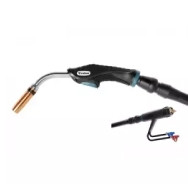
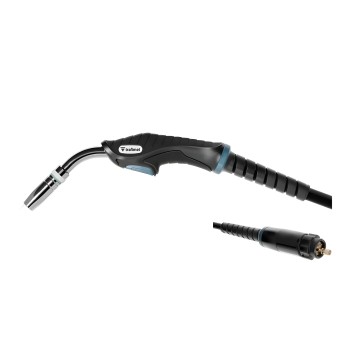
The MIG torch is the tool held by the welder to guide the wire and shielding gas to the workpiece. As the central element of the semi-automatic welder, the MIG-MAG welding torch determines comfort and bead quality. Discover our selection of torches and their consumables.
The role of the MIG torch
The welding torch delivers wire, current, and shielding gas simultaneously to the welding point. It includes a contact tip that transfers current to the wire, a nozzle that channels the gas, and a trigger that controls wire feeding. A MIG torch in good condition is the prerequisite for a stable arc and a consistent bead on the MIG-MAG welder.
Air-cooled or water-cooled?
As with the TIG torch, the first criterion is cooling. The air-cooled welding torch suits moderate amperages and everyday work. The water-cooled torch is essential for high amperages and extended welding. The choice depends on the required duty cycle and the working amperage.
Torch consumables
The welding machine torch has several wear parts: the contact tip (the most consumed part), the nozzle, the diffuser, and the wire guide liner. These MIG accessories must be replaced regularly to maintain smooth wire feeding and good gas shielding. The wire feeder's drive rolls complete the circuit.
Compatibility with the welder
The welding torch must be compatible with your welder: connector type, supported amperage, and cable assembly length. An undersized torch overheats and wears out prematurely; an oversized one is heavy and unwieldy. Check your welder's specifications before choosing.
Comfort and ergonomics
The comfort of a MIG-MAG welding torch matters, especially during long sessions: weight, flexibility of the cable assembly, grip of the handle, and trigger quality. An ergonomic torch reduces fatigue and improves bead precision. For professional welders, a quality torch is an investment that is felt immediately.
Daily torch maintenance
The MIG-MAG welding torch requires regular maintenance to perform at its best. After each session, clean the nozzle and apply an anti-spatter product to prevent spatter from sticking. Check the contact tip and replace it as soon as the bore is enlarged. Blow out the liner with compressed air to remove metal dust. These few-minute tasks preserve the quality of wire feeding and gas shielding.
Choosing the right cable assembly length
The length of the MIG torch cable assembly affects manoeuvrability. A short cable assembly is light and manoeuvrable, ideal for workshop tasks close to the welder. A longer cable assembly provides extra reach for large workpieces or workstations far from the power source. Choose the length according to your setup, bearing in mind that an excessively long cable assembly can make the torch heavier and reduce comfort during long sessions.
Torch and process
The welding torch is also chosen according to the process and the metal. For flux-cored wire, the standard liner is suitable; for aluminium wire, a Teflon liner is required. For stainless steel wire, a clean, dedicated circuit is preferred to avoid contamination. The MIG torch is therefore an adaptable element, whose consumables and configuration evolve according to the work to be carried out.
An investment you feel immediately
Switching from an entry-level welding torch to a quality model is felt from the very first bead: better grip, more flexible cable assembly, better gas shielding. It is a modest investment compared to the welder itself, but its impact on comfort and work quality is immediate. For welders who work daily, the torch is the most-handled tool: it should be the best possible, with quality consumables and a flexible cable assembly suited to your workshop configuration.
For occasional welders, a mid-range welding torch covers the majority of needs without unnecessary extra cost. For professionals, robustness and a flexible cable assembly justify a higher investment that is felt on a daily basis.
Our recommendation
Choose your MIG torch according to the working amperage (air-cooled for everyday work, water-cooled for high amperages), compatibility with your welder, and ergonomic comfort. Keep a stock of consumables (contact tips, nozzles) and apply an anti-spatter product to the nozzle to extend its service life. Browse our selection of torches for MIG-MAG welders.
Frequently asked questions
How do you choose a torch for a MIG welder?
According to the working amperage (air-cooled for everyday work, water-cooled for high amperages), compatibility with your welder (connector, amperage, cable assembly length), and ergonomic comfort (weight, flexibility, grip).
What are the consumables for a MIG torch?
The contact tip (the most consumed part), the nozzle, the diffuser, and the wire guide liner. These wear parts are replaced regularly to maintain smooth wire feeding, good gas shielding, and a stable arc.
Air-cooled or water-cooled MIG torch?
The air-cooled torch suits moderate amperages and everyday work: simple and economical. The water-cooled torch is essential for high amperages and extended welding, as it prevents overheating.
How do you maintain a MIG torch?
Regularly replace worn contact tips and nozzles, clean the nozzle with an anti-spatter product to prevent spatter from sticking, and check the condition of the wire guide liner. Good maintenance ensures a stable arc and a clean bead.


 Italy
Italy
 Germany
 Netherlands
 Croatia
 Denmark
 Finland
 Greece
 Ireland
 Sweden
 Norway
 Bulgaria
 Estonia
 Latvia
 Lithuania
 Poland
 Czech Republic
 Romania
 Slovakia
 Slovenia
 Hungary
 Spain
Spain



 2-year warranty